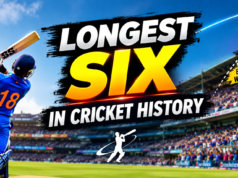
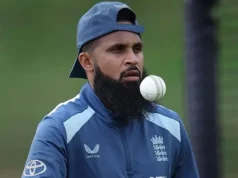
Cricket is a sportsmanship, it’s Speedy, Steady and Power increasing sport. A well-timed cover drive or a picture-perfect straight drive is what every cricket lover wants to see but nothing beats the thrill of a massive six going over the fences. We have seen many powerful hitters propelling the ball to incredible distances over the years. It is often cited as one of the most intriguing conversations among cricket devotees, especially since it has made sixes in cricket history across continents.
Be it a legendary international cricketer or a modern-day powerhouse, several cricketing personalities have had their own place in helm an articulate dance of magnificent hits that some even today the cricket lovers would go on to discuss. Players like Shahid Afridi, Brett Lee, MS Dhoni, Chris Gayle and Liam Livingstone are known for their sixes. But the official longest six is difficult to ascertain, with some distances differing by reporting.
In this article we discuss about the biggest sixes of cricket, names of players who hit enormous an absolute maximum well put along well put the factors that help a cricket ball to travel awesome distance.
What Is the Longest Six in Cricket History?
The longest six in cricket is most commonly understood to be a hit that flies far the distance (from where it leaves the batter’s bat to wherever it lands). Shahid Afridi: While many reports that have been doing the rounds list Afridi’s name amongst those with one of the largest sixes in cricket history, he has enviously measured up a distance of nearly 160 metres.
But the distance itself is the subject of dispute, and no single measurement has universally been accepted as a definitive basis to label one shot as the longest six ever hit. The oldest rosters have often been based on estimates without modern tracking technology.
The difference is essential because a distance documented does not equal an official world record. The final number can be altered by a variety of factors, including stadium dimensions, the flight of the ball, measurement techniques and what video is available.
However, the debate continues to baffle cricket lovers across corners of the boundaries. With one of the batters hitting a ball into the crowds, it is always time for fans to start comparing that shot with some of the biggest sixes seen in cricket — ever.
Shahid Afridi-one of the Most Powerful hitters in cricket history
One of the names most synonymous with the longest six in cricket history is former Pakistani allrounder Shahid Afridi. The aggressiveness of the ex Pakistan all-rounder, his ability to score quickly and hit a ball very hard outside the ground propelled him into prominence.
Comprising set batsman Khan and Rameez, Afridi was considered a traditionally aggressive batsman who would take the attack to Bowlers. Waiting for loose deliveries was not during his time, he tried to up the ante by taking a couple of crunched blows which could change an entire match in one over.
A reported six of about 160 metres is often associated with the name. While this distance is not independently confirmed, it stands to emphasize the reputation Afridi established as one of his generation’s biggest hitters.
The fact that he was unflappable made him very dangerous in limited-overs cricket, where a couple of massive sixes could change dire straits into a chaseable total.
It is one shot — and yet it is not just a single shot that defines Afridi’s legacy. His hard hitting, his performances with international spectators and most importantly, the ability to get the crowd excited made him one of cricket’s household names for power hitters.
Brett Lee – Another Quick Who Packs a Punch With the Bat
Brett Lee is best known as one of Australia’s fastest fast bowlers, but he had surprising hitting power too. While taking wickets was his primary role, Lee occasionally delivered a few blistering blows that showed just how powerful he could be.
A fast bowler would bowl under the most challenging batting conditions, particularly if they arrive at an innings close. That was where Lee could find a way to turn those opportunities — the cavalier attacking upon which his career built its reputation — into fun, hitting the ball either out of or over the boundary.
His name is mentioned in connection with some of the longest hits in cricket, although distances for individual shots will be reported with due skepticism.
Lee’s batting was relatively simple and aggressive. He didn’t always push more advanced stroke work, he could hit the bejesus out of a ball when he caught it flush.
His knockings remind fans that giant sixes are not simply the purview of specialist batters. Even non-batsmen can give us some great batting displays.
MS Dhoni – Helicopter Shot Specialist
One of the most celebrated captains and batsman, we all know MS Dhoni as that cool headed guy who leads like a pro (here’s why you need to download this breakup album!) his bull doze innings endowing his team mate with victory right when it matters. The ex-India captain became known for smashing big sixes, especially towards the end of T20 and ODI games.
The helicopter shot became one of the most iconic batting strokes used in modern-day cricket, thanks to him. That unique wrist movement allowed him to generate power and hit the ball smoothly in the direction of the boundary, regardless of how difficult a delivery was.
Dhoni’s immense experience stood the team in good stead when India found itself thrusted to rescue mode. He was a scary finisher in international cricket and the Indian Premier League because he did not panic while going after bowlers.
And even if Dhoni is not the holder of the longest six in cricket history, he remains one of its most memorable six-hitter.
His influence shows that hitting for distance is merely one aspect of big hitting. Equally important, apart from timing and decision-making, is getting in the runs when the team needs them.
Chris Gayle – The Six-Hitting Kind Of Universe Boss
One of the most destructive batsmen to ever play in T20 cricket is Chris Gayle. If we speak of The Universe Boss, the West Indies champ combined massive power with wonderful timing and a no mercy aggressivity.
His immense six-hitting ability made him a huge draw in franchise cricket, and one of the most ruthless entertainers with giant heaves. His performances in IPL and other T20 competitions earned him the parlance that a single batter can take away games by keeping up brutal hitting.
While players who relied primarily on wrist work swung the bat, Gayle would mostly go for a clean swing powered by his body and often sent them soaring into the stands. Despite facing bowlers from good bowling units, he was a man who broke shoulders when he found his rhythm.
One of the greatest T20 careers and one of the most natural choices for any discussion amongst cricket enthusiasts about the most powerful hitters ever.
While first-class distances gained from Gayle vary, his mega six-hitting ability is all but endorsed by the long, loud and often-specific explosive aggregate he’s sprinted up to now in his cover.
Liam Livingstone – The Power-Hitting Gun of Modern Cricket
The plundering England batsman Liam Livingstone will bring with him from the modern era a type of modern-day hammer-fisted basher, built to hit massive sixes against both seam and spin.
The England international has gained a reputation in T20 leagues and international cricket for hitting the ball out of the ground. In the middle and final overs, he uses his power-packed physique, rapid bat speed and lean-forward instinct to great effect.
Livingstone is a ball hitter who doesn’t have to mine one specific scoring zone for runs. He uses a straight bat, hits legside, and can hurt bowlers with short balls.
Just the fact that they use modern broadcasting technology means viewers can now better appreciate how high and how far mega-hits were. Consequently, enormous sixes of players like Livingstone are routinely converted into Bet terrible god social media highlights.
Though this very achievement does not set an official world record for his biggest hits, it embodies the evolution of power hitting in modern cricket.
Yuvraj Singh – The Six-Hitting Legend Of T20 Cricket
Because of his aggressive batting and ability to dominate bowlers, Yuvraj Singh is not only an important batsman in their middle order but he holds a special place for Indian cricket.
His record of six hitting when he hit 6 6’s in an over off England’s Stuart Broad during the 2007 ICC Men’s T20 World Cup, is widely considered his most iconic. It was one of the moments of the tournament, one of those ridiculous performances.
There is a clear difference between six sixes in an over and hitting it individually the longest but Yuvraj’s case goes to prove the impact of a power-hitter in a space of 10 balls.
His style as an attacker blended bat speed, timing, confidence and great hand-eye coordination. His ability to have sixes against fast bowlers as well as spinners made him a serious threat in limited-overs cricket.
Yuvraj may not have an officially proven best record for the longest six, but he did impact cricket’s huge hitting culture in a way that has resonated ever since.
Why Does a Cricket Six Travel So Long?
There are a few factors affecting how far a cricket ball can carry after being hit by the batter. So Yes, physical strength matters but it is only part of the process.
1.Bat Speed
With a more rapid bat swing, you can give the ball additional energy. Elite power hitters have honed that timing to take a big swing while directing the ball.
2.Timing and Contact
Clean contact is essential. If a batter makes contact with the ball closer to the sweet spot of the bat, less energy is lost and the ball will go further.
3.Launch Angle
Moreover, the angle at which a ball comes off any bat greatly affects its traveling process. A super low shot might travel fast but hit the surface early, on the other hand a post extremely high will lose distance. This angle is closely correlated to the speed of the ball, the batter’s swing and weather conditions.
4.Bowling Speed
A fast delivery alone contains a lot of energy. But that energy can go a long way when a batter harnesses it with a big swing. A slower delivery too, however, has taken on an absolute distance when the timing is perfect.
5.Wind and Weather
Things like wind direction, the density of air and weather conditions can make a difference in the distance travelled by a cricket ball. A good wind is likely to get a well-hit ball carrying further whereas a fairly stiff headwind will certainly reduce distance.
6.Ground Dimensions
Even the size of a stadium has an impact on whether a shot completes as six and how long its range is considered. For instance a ball driven over a short boundary might go for six, but a similar shot at a larger ground would not reach the rope.
Why Is It Difficult to Identify the Official Longest Six?
Cricket has been played for over a century at the international level, but distance measurement accuracy was not always guaranteed. The clear gem of older reports often included visual estimations, commentary, or measurements that may not be easily confirmed by outside observers.
Recent innovations demonstrate the level of detail that can be captured through ball tracking, camera systems, and video analysis. However, depending on the method of measurement used, various points along the flight of the ball may be identified, which can lead to different results.
There is also a distinction between how far a ball goes in the air and how far it would travel along the ground if its entire flight path were projected onto the surface.
Such claims, even at 150 metres or 160 metres for six, should always be treated with caution before being recognised as official records. A responsible cricket article is required to separate between a great distance that has been reported and one that has been formally confirmed.
Conclusion
The search for the longest six in cricket history brings together some of the sport’s most exciting players, including Shahid Afridi, Brett Lee, MS Dhoni, Chris Gayle, Liam Livingstone, and Yuvraj Singh. Each has contributed memorable moments that demonstrate the extraordinary power and skill required to hit a cricket ball beyond the boundary.
Shahid Afridi is frequently associated with a reported six of around 160 metres, but that distance remains disputed rather than universally established as an official record. The lack of consistent measurement methods makes it difficult to identify one definitive winner.
Ultimately, the fascination with the longest six goes beyond numbers. These shots represent courage, technique, athletic ability, and the excitement that makes cricket special. As modern players continue to push the limits of power hitting, fans can expect even more spectacular sixes in the years ahead.
Whether the next record-breaking hit comes from an international superstar or an emerging young batter, one thing is certain: the biggest sixes will continue to create unforgettable moments in cricket history.